

Last month, we did an offline event for the pmcurve community in Bangalore. A common question on everyone’s mind?
How is product management going to evolve in the next 3-5 years and what can we do about it?
The first part of the question isn’t that interesting, partly because speculating 5 years ahead in a world changing so fast due to AI is naive. A better thing to do is to look forward to next 12 months, and pick skills which protect you or even help you thrive in the age of AI. So what are the skills once should be focussing on? The answer depends on where you are in your PM journey.
In this post, we talk about four segments: Aspiring PMs, IC PMs, PM Managers, and Product Executives.
Aspiring PMs: The Bar Rises to Get into PM
The path to get into product management till now has been —learn frameworks, do a bootcamp, and land a junior PM role. Junior PMs roles so far were all about execution - writing feature PRDs, running experiments, updating stakeholders, sprint planning, etc. AI has made many of the execution tasks easier so that it can be done by a seasoned PM in much lesser time. Claude or ChatGPT acts like a junior PM intern for seasoned PMs to whom they can delegate mundane tasks. This has led to an overall decrease in junior roles.
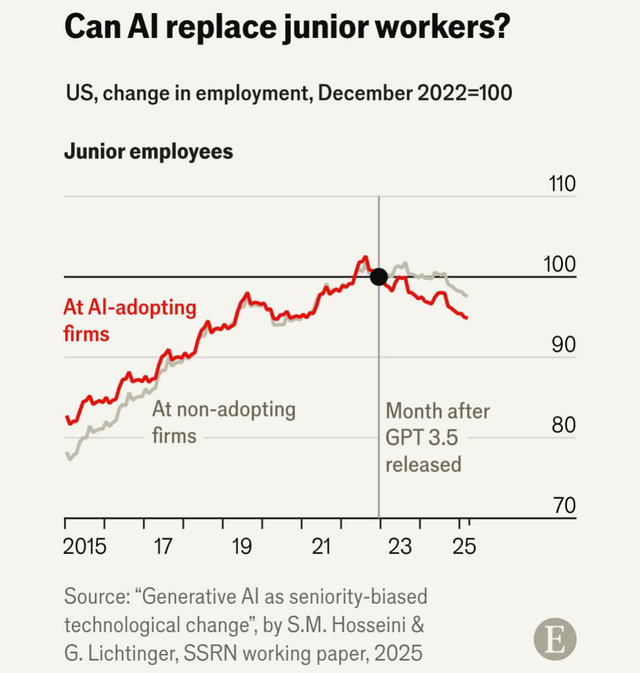
But not just that, AI has also led to a change in expectations from a junior PM. Companies increasingly expect junior PMs to be AI-native because they can add value from Day 1. So if you are aiming to get into product management, you have to go above and beyond learning frameworks, do a bootcamp, and go through interviews.
Here are the top things you should prioritize:
Technical fluency with AI tools: You need to build comfort working with AI tools. Learn to use Claude, and ChatGPT, for research and analysis. Use Lovable and Cursor for prototyping.
Build a portfolio: For the first time in product management history, a non-technical PM can be a builder as well. Hiring managers are looking for builders who can recognize a pain and solve it. Ship a small AI-powered tool for personal use, or build a product to solve a need others are facing using AI prototyping tools. Create a Github profile or portfolio page and post your projects there. You can draw inspiration from your designer friend profiles where they showcase what they have designed.
Higher skill level: Build domain depth using deep research for companies you are applying to, have some really good questions to show your judgement. The bar for product sense/ judgement has gone up because a PM with mediocre judgement will not be able to refine AI outputs and take it to the next level.
You need to operate like someone with 2-3 years of experience on day one. Fortunately, AI products such as Claude or OpenAI can help you learn faster, and you can become a builder by using Cursor/ Lovable sort of tools.
IC PMs: Two Paths Forward
For IC PMs, two distinct paths are emerging. Both require AI fluency, but they lead to very different careers.
Path 1: Becoming a Super IC
Every PM has access to AI tools that can generate output in terms of list of features a product should build, feature PRDs, user stories, market research, product strategy, prioritization of features, etc.
This enhances the ability of a PM to generate output by 10-100x. You can write 10 PRDs in a day, whereas a single PRD used to take 10 days earlier. But LLMs aren’t reliable. They can generate very plausible outputs, but fail to judge the quality of these outputs reliably.
And so PMs have to exercise their product sense and strategy more and more on the output generated by LLMs. This fundamentally shifts a PM job from creating the entire output like a PRD or user stories or market research documents, to evaluating generated output from LLMs.
Super IC PMs use AI as their productivity multiplier. They leverage Claude, Cursor, and other AI tools to significantly enhance their output by doing work that previously required a larger team.
The core skills required to be a Super IC can be understood by looking at the Venn diagram below from a course I run.
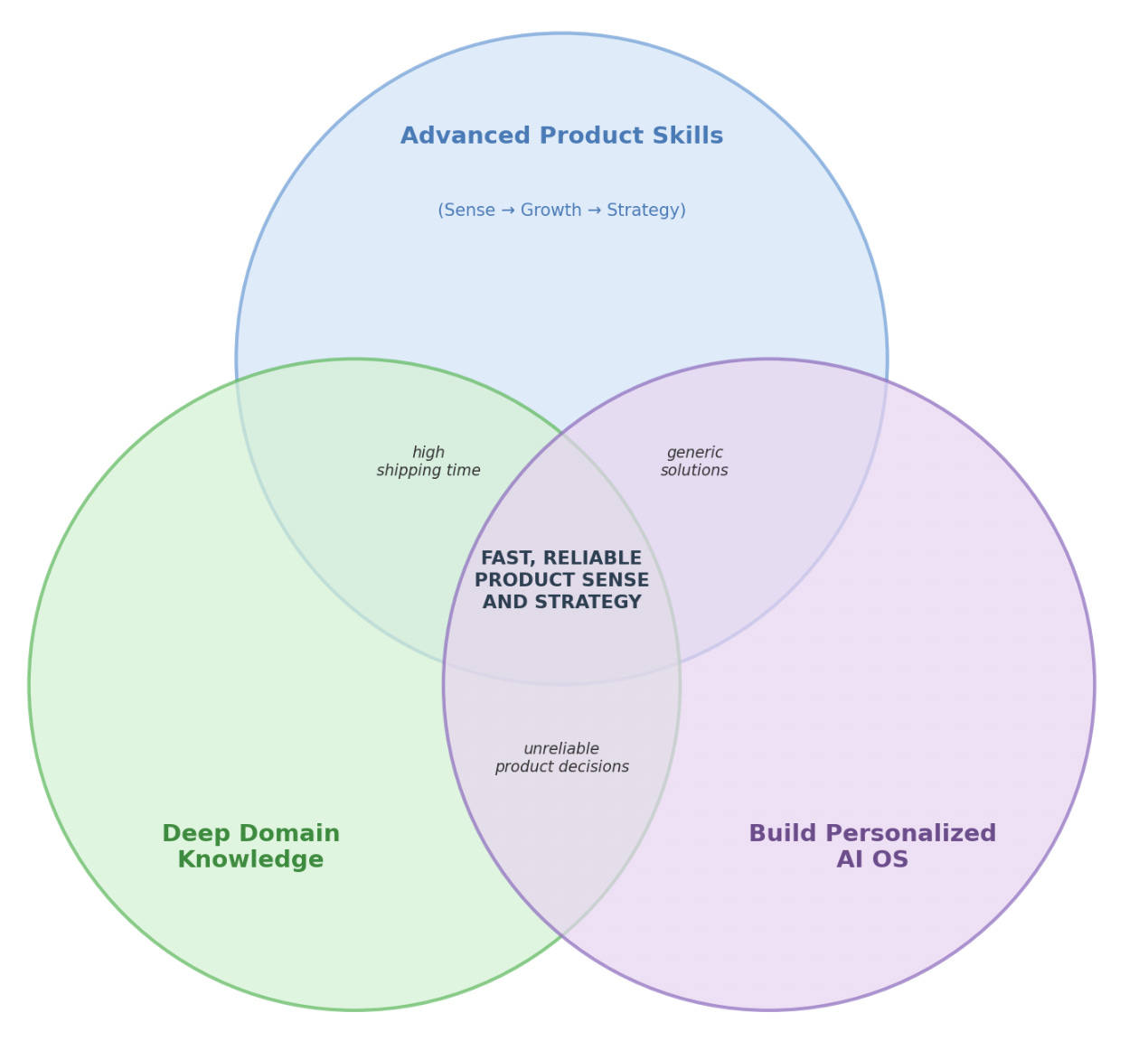
Here are the top things you should prioritize if you are on this path:
Product judgment. When you can build significantly faster with coding agents, deciding what to build that creates both short-term and long-term advantage becomes necessary. A solid judgement requires deep domain knowledge and advanced knowledge of product sense, growth, and strategy. It’s not that this skills wasn’t required earlier, but the premium on the skills has increased due to AI.
AI Fluency: Learning basic tools and prompt engineering has become mandatory and every PM is using AI in some form or other at work. The advantage lies in how deeply fluent are you in AI. The litmus test for this is whether you have your OS consisting of AI workflows, prompt library, and more at work. Best PMs I know have created a different system of work.
Becoming a super IC isn’t going to be a choice for long, every PM has to graduate to this.
Path 2: Becoming an AI PM
AI PMs don’t just use AI tools—they build AI products. They understand LLMs architecture well, can debug hallucinations, and make architectural decisions such as model selection using rigorous evals.
This is the path that leads to AI-native companies like Anthropic and OpenAI, or to senior roles at startups building AI products.
Here are the top things you should prioritize if you are on this path:
Deep technical understanding of AI. Understand LLMs, RAG, fine-tuning, prompt and context engineering, model selection, etc. You don’t need to write code like an AI engineer level, but need to have ability to hold discussions around architectural decisions/ trade-offs.
Build AI products yourself. Ship AI-powered features or products end-to-end if you aren’t in the role yet. The learning comes from doing—understanding failure modes, UX tradeoffs, and evaluations. That’s a reason the course I run for AI product management has the Capstone where learners have to build production-ready AI products.
Domain expertise in AI applications: AI product sense and strategy is what a PM brings to the table. You need to build deep domain knowledge of AI products, and ability to predict where the domain is moving.
This path is for you if you’re drawn to the technical role such as a platform PM. But it’s a misconception that it’s only a technical role. The misconception exists because currently most AI companies such as Open AI/ Anthropic are operating at platform layer. That’s changing as the industry is moving to the application layer. More and more AI PM roles are going to be application-oriented. So even a consumer or enterprise PM who doesn’t want to do a heavily technical role can aim for this. An example is PMs who are building support agents in different organizations, are use-case/ application focussed, rather than being tech-focussed.
PM Managers: Might See Maximum Disruption
You can’t manage what you don’t understand. And that’s true about PM managers as well. If they don’t have any builder experience in AI, how can we expect them to manage AI products, or AI-native product teams?
That’s one of the reasons leaders in silicon valley are advocating PM managers to be a builder again, or gain some builder experience. After all, your ICs are becoming Super ICs or AI Builder PMs. If you don’t understand what they’re doing, you can’t help them do it better. And if you can’t help them, why do they need you?
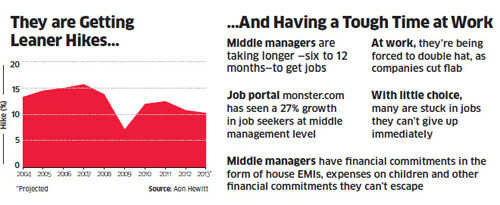
The trend can be seen in middle management jobs (source)
Here are the top things you should prioritize if you are a PM manager:
AI fluency: You don’t need to be as deep as your AI PMs, but you need to understand enough to make sound decisions.
Coaching Super ICs and AI PMs/Builders: These two types of PMs will need different things from you. Super ICs need help with prioritization, strategy, removing blockers for them, etc. AI PMs need help with impact assessment, technical tradeoffs, and stakeholder alignment on AI-specific risks. You will need to manage them differently.
Hiring for the new archetypes: Interview loops, and evaluation criteria for a new hire needs to change to accommodate new reality. You company probably still optimizes for traditional PM skills. Update them. Look for AI fluency in hiring. Test for it.
Strong judgment: As teams can ship things faster, this could lead to faster disasters in lack of strong judgement. Your judgement is solid for an era when shipping speed was slower, so it needs an update. And that’s not the only area - building AI product sense and strategy becomes super important as well.
Building a learning culture around AI: Your team needs space and budget to experiment with AI tools. Some will adopt fast, others will resist. Set clear expectations and competencies in AI fluency. Celebrate PMs who ship using AI tools. Have honest conversations with those who won’t adapt and help them learn and adapt.
The PM managers role demand much more, and you have to master multiple skills while doing your full-time job. That’s what makes it so difficult.
Product Executives: Culture and Strategy Changes
If you’re a VP of Product or CPO, your focus is how culture and strategy needs to change in the light of AI. Here are few things to focus on:
Early wins: There is a good chance you understand the importance of early wins around any new strategic initiative, and AI isn’t different. The place where AI becomes different is that it isn’t deterministic like other pieces of software you have dealt with. The probabilistic nature of AI can elude impact that you are planning since it’s hard to predict impact in advance. Best way to get an early win here is to talk to multiple experts and form your thesis. This is what you have always done when entering a new domain. Treat AI as a new domain/ territory.
Speed vs Hit rate: AI improves shipping velocity, but that is a double-edged sword. You have to make both faster and better decisions, something which is really hard to do. In a zest to deliver many things, you might end up building wrong things. People who are telling you that it improves your impact ultimately don’t understand the nuances of product management and consumer psychology. If most of what you ship is useless to consumer, they start doubting if the product is right for them and will try alternatives. In enterprise, it’s an entirely different story. Someone with better decision making will end up winning your accounts. So your competitive advantage isn’t speed, it’s speed x hit-rate on features shipped.
Restructuring and change management for AI-native work: How do you restructure your team in this new era? With AI, the stack-rank of initiatives also changes. You may need to rethink team composition and headcount allocation. And this won’t be just product team. Engineering, design, and other functions are going through similar shifts. You need to lead cross-functional alignment on how AI changes ways of working. How do you tap into new efficiencies? What does a product trio look like when the PM can prototype? These are organizational design questions, and you need to answer them.
Managing the board, peers, and CEO: The board, CEO, and cross-functional peers are looking at CTOs and CPOs for guidance. You need to be the voice of clarity along with your CTO, and create a coherent strategy + plan together. Failing to shape the conversation can prove detrimental to both company and your career.
To be honest, this is a role (VP/CPO) where I have limited experience, but I have been fortunate to connect with many of them because of pmcurve, and these pointers are based on my personal experience as an entrepreneur running the company, and my conversations with product executives.
Wrapping it up
Regardless of where you are, AI accelerates execution and is a new skill/ set of skills to pick in 2026 and beyond.
Here’s what to focus on based on your level:
Aspiring PMs: Be AI-native, produce senior-level output, go deep in one domain/ segment, build a portfolio that proves it.
IC PMs: Choose your path—Super IC or AI PM Builder
PM Managers: Build technical fluency, coach the new PM archetypes differently, learn to hire for AI-native skills, faster and better judgment
Product Executives: AI strategy, restructuring your org, change management, managing expectations through early wins and conversations
2026 could be a significant inflection point for product management. It is also possibly the best time to reassess where you are and what you should optimize for.
—Deepak
insightful for an aspiring pm