

In 2010, a high school Japanese student, Shohei Ohtani, created a detailed "dream sheet" with one central goal: to be the #1 draft pick for 8 NPB (Nippon Professional Baseball) teams. NPB is a professional baseball league and the highest level of baseball in Japan.
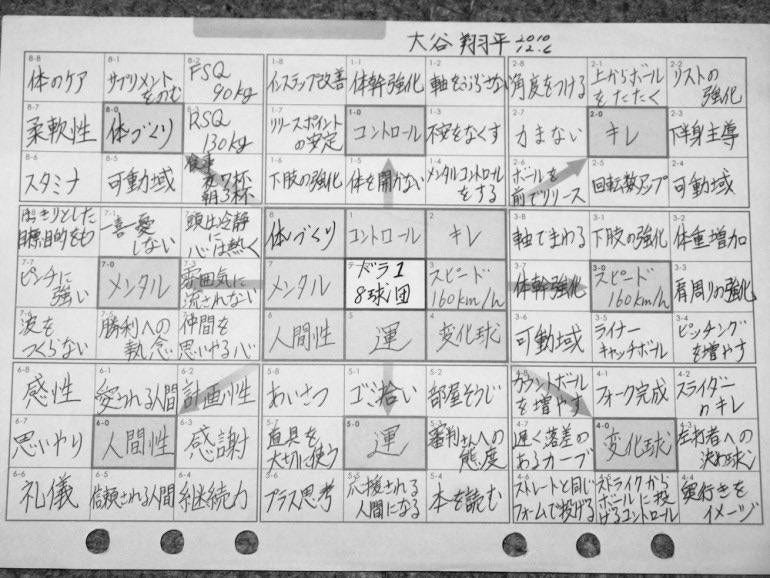
A decade later, he became the most valuable player for Major League Baseball (significantly bigger than NPB). His contract is worth $700 million and he is one of the legends of the game.
The sheet that you see uses a method called Harada Method — developed by a track coach, Takashi Harada, in 1990s.
Here is the English translation of the map Shohei Ohtani made
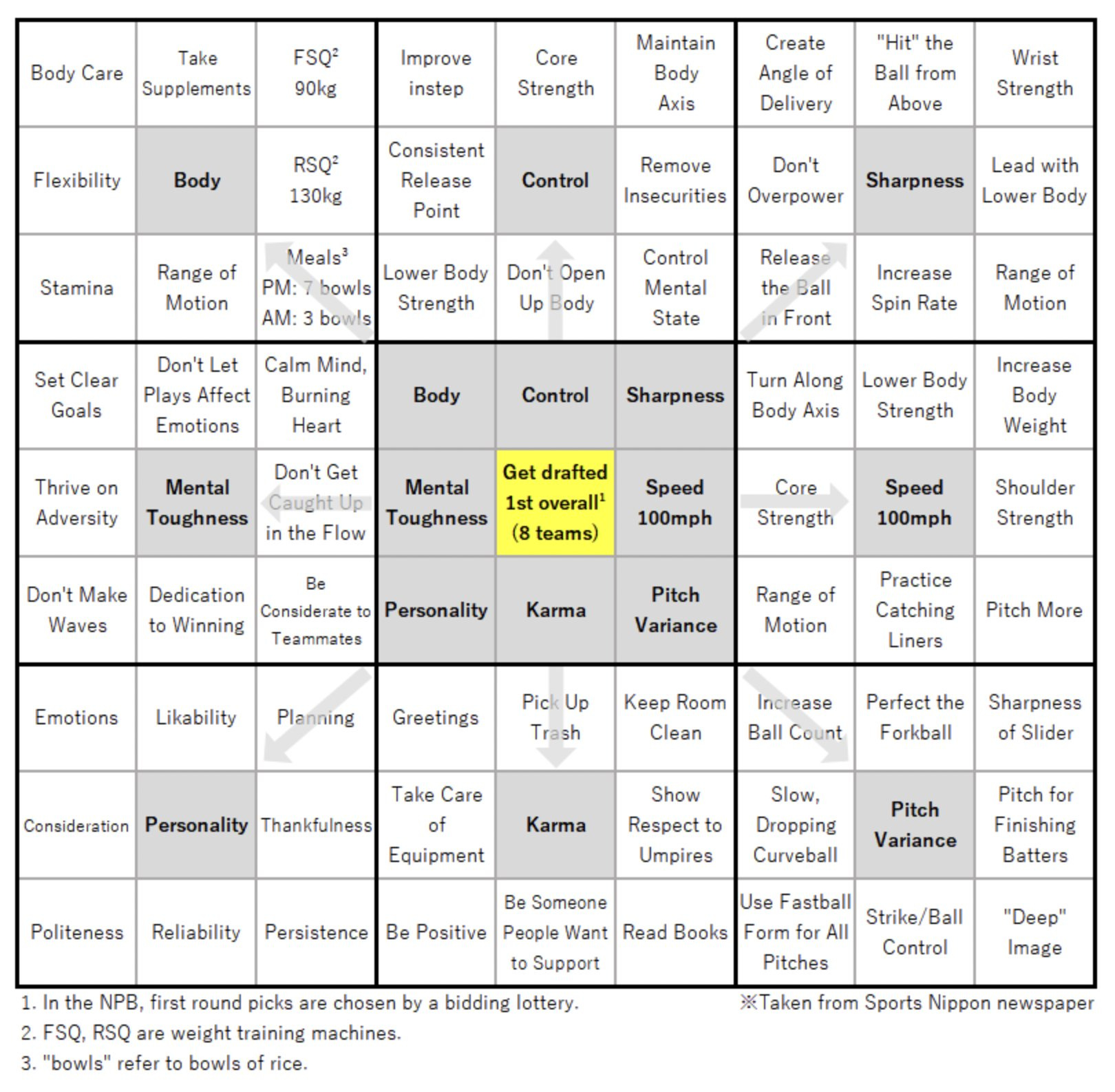
The Harada Method
The Harada method consists of 5 steps:
Determine your objective or goal.
Mapping key competencies affecting the goal
Develop action plan (skills and tasks) to master in order to attain your goal
Figure out your strength and weakness
Get coaching, receive feedback/guidance to improve your weaknesses
I have been fascinated by this method. It forces you to break a larger goal into manageable tasks/ competencies to master.
So a question I asked myself was — what would a Harada Map look like for a PM trying to perfect his/her craft of product management? This post talks about just the same. It starts with
Step 1: The Objective
One of the things most good PMs get quite right is their focus on creating impact. This could be in terms of getting more users for the product, or increasing revenue, or something else. But compelling impact is the right proxy that you are mastering the craft of building valuable products
PM is unlike structured domains such as maths and computer science where how good you are at it, can be objectively judged by a peer or assessment. A good or bad product decision is often judged by whether the market or the customer like it, get value from it, and are willing to pay for it. Looking that way, product management is similar to investing or business where there is no clear, objective answer you can deduce from first principles directly.
So when you chase and create impact as a PM, everything else follows - meaning, learning, promotions, salary, reputation, etc. It’s good for your company, good for the customer, and a clear sign that you are a good PM. That makes it the right objective for the Harada map of product management.
Before we move forward, let’s make sure we understand impact a bit deeper by breaking it down.
Breaking Down Impact
We can write an equation for impact as follows:
Impact (I) = # of tasks done (X) * Impact per task (Y)
If we are looking to be better at achieving it, we can focus on increasing our # of tasks done * impact per task.
# of tasks done is directly impacted by the systems, templates, and tools that we use. AI as a tool has been the biggest contributor to productivity in recent times. It can write PRDs in 10 minutes that used to take days. It can generate competitive analysis instantly and synthesize user research at scale. The output might not be world-class, but it’s above average in majority of cases.
Let’s talk about Impact per task. The way to understand it is that as people move up, they are supposed to increase their impact per task because the # of hours one can put in is limited. For example, they are expected write updates less which is a low-impact task, and instead invest that time in launching new initiatives, thinking of new ways of building a defensible business, etc. which are high-impact tasks. In short, the higher the paycheck and title, the higher is the impact expected from you. The corollary to this is — if you can’t show higher impact in your career, your career would stall.
AI isn’t the answer
While using AI improves productivity, it can degrade your impact per task by degrading decision quality. It depends on how you use AI.
MIT research (June 2025) found that 80% of users who used LLMs to write essays couldn’t recall what they’d written in these essays. Further, the convenience came at a cognitive cost—using AI diminishes users’ inclination to critically evaluate the LLM’s output.
Reducing the struggle to do cognitively demanding tasks isn’t always a better option. For example, when you struggle to write a positioning doc, it helps you develop strategic thinking.
AI makes you faster by eliminating that struggle. But it can be detrimental to judgement, thereby reducing Impact per task (Y).
So while using AI to improve execution pace is great, it needs to be done selectively and carefully.
Now that we have understood impact well, let’s move forward to figure out 8 key skills that affect impact of a PM in a role
Step 2. Skills <> Impact Mapping
A PM job isn’t uniform across companies, or even within a company. So the skills needed to create impact at one place might be different (though overlapping to a good extent) than the one at another place. This makes it difficult to create a single map, or does it?
Stephen King, the famous author, writes about the concept of toolbox in the book ‘On Writing’
One summer when Stephen King was a young boy, he helped his Uncle Oren, a carpenter, repair a screen door on the side of his house.
“I remember following him with the replacement screen balanced on my head, like a native bearer in a Tarzan movie,” King recalled. Oren meanwhile lugged his toolbox, bulging with tools and weighing in at nearly 100 pounds, “horsing it along at thigh level.”.
‘There was a hammer, a saw, the pliers, a couple of sized wrenches and an adjustable; there was a level with that mystic yellow window in the middle, a drill (the various bits were neatly drawered farther down in the depths), and two screwdrivers. Uncle Oren asked me for a screwdriver.”
Wielding the simple tool, Oren speedily removed the eight screws that secured the broken screen and attached the new one. But King was puzzled. He asked his uncle why he’d lugged the toolbox all the way around the house “if all he needed was the screwdriver. He could have carried a screwdriver in the back pocket of his khakis.”
“Yeah, but Stevie,” he said, bending to grasp the handles, “I didn’t know what else I might find to do once I got out here, did I? It’s best to have your tools with you. If you don’t, you’re apt to find something you didn’t expect and get discouraged.”
I find this analogy pretty good to explain why a PM needs to have the entire toolbox of skills even if they aren’t using all the skills in a particular job to create impact. The problem is you will never know what you don’t know.
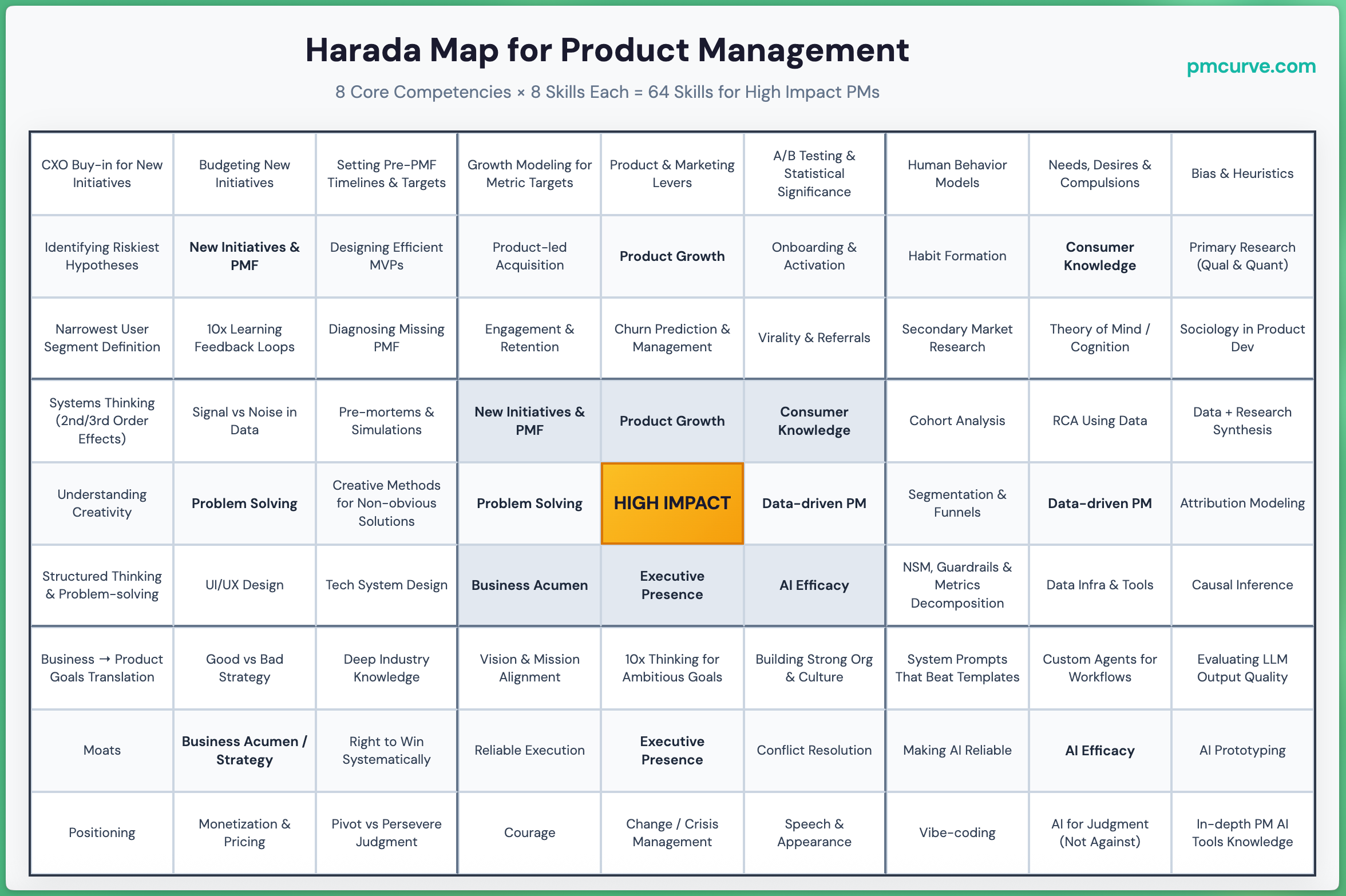
Here is a set of skills, most relevant to creating impact
Ability to identify new, strategic initiatives + getting it to product-market fit (New Initiatives and PMF)
Scaling a product once it achieves PMF (Product Growth)
Finding valuable consumers problems through research (Consumer Knowledge)
Data-driven product management (Analytical)
Solving a consumer problem well (Problem Solving)
Monetizing products to hit business goals, and build long-term defensibility (Business Acumen and Strategy)
Aligning everyone to a worthy goal and roadmap (Executive Presence)
AI efficacy to use AI effectively. Please note that we are using the word ‘efficacy’ and not ‘fluency’ here.
So where does product sense/ taste lies? Product sense is a combination of few competencies - consumer knowledge, problem-solving, data, strategy, etc.
Step 3. Skills <> Competencies Mapping
Let’s go after skills one-by-one. We are trying to be directionally accurate as much as possible. If we can cover 90% of product management craft in this map, we can count it as a success.
1. New Initiatives and PMF
Get buy-in from CXOs on a new initiative
Budgeting a new initiative
Setting timelines and targets in a new initiative pre-PMF, which is often pretty difficult
Identifying riskiest hypothesis and designing most efficient MVPs
Defining initial set of users in the narrowest segment possible
Building feedback loops in a new product for 10x learning
Diagnosing why PMF isn’t there
Recognize when to pivot vs persevere
2. Product Growth
Setting achievable metric targets through growth modelling
Identifying product and marketing levers of growth
A/B testing design and statistical significance
Product-led acquisition
Onboarding and activation
Engagement and Retention
Churn prediction and management
Virality (and referrals)
3. Consumer Knowledge
Human behavior model
Human needs, desires, and compulsions
Bias and Heuristics
Habit formation
Conducting primary qualitative and quantitative research
Secondary market research
Theory of mind/ cognition
Sociology in product development
4. Problem Solving
Systems thinking to see second and third-order effects
Separate signal from noise in data and research
Running pre-mortems and simulations well
Understanding creativity
Mastering methods to exercise creativity and generate non-obvious solutions
Structured thinking and problem-solving
UI/UX Design
Tech System Design
5. Business Acumen/ Strategy
Translating business goals into product goals
Understanding good vs bad strategy
How to build deep industry knowledge
Moats
Finding and building right to win systematically
Positioning
Monetization and Pricing
6. Data-driven Product Management
Cohort analysis
Conducting RCA using data
Mapping data to research to understand why
Segmentation and Funnels
Attribution modeling
NSM, guardrails, and metrics decomposition
Data infra and tools (event taxonomy, warehousing, analytics)
Causal inference
7. Executive Presence
Aligning execution to vision and mission
10x thinking to set ambitious goals
Building and hiring a strong org and culture
Reliable Execution
Conflict resolution
Courage
Change/ crisis management
Speech and appearance
8. AI Efficacy
Write system prompts that beat generic templates
Build custom agents for your specific workflow like research, task management, etc. to create your personal productivity OS
Evaluate LLM output quality rigorously
Making AI reliable
AI Prototyping
Vibe-coding
Building systems to use AI to help judgement, not hurt it
In-depth knowledge of AI tools relevant for PMs
Here is a summary of all these skills:
Step 4. Strengths and Weaknesses
In this step, you can make an initial list of skills and competencies that you need to work on. We all have some blind spots, and it’s harder to figure for PMs since the objective problems are missing. The way to figure out our blind spots in the professional setting is by looking at our past performance reviews, seeking additional feedback from managers/mentors, etc.
I also find interviews a great way to figure out your blind spots. By finding the problems that can map to all these competencies, and solving those problems, you can get a reasonable idea on whether you understand a task well or not. How do you find such questions/ problems? You can get it from various PM interview sites, but if you need a more detailed answer from my end - let me save that for the next post.
Step 5. Working towards excellence
This is the final piece once you have figured out what to work on. Tools that can be helpful here are
learning via books, papers, blogs, courses, videos, etc.
applying the competencies on the job
applying the competencies to produce high quality solutions to PM questions
We plan to publish questions that can help you assess various competencies/ skills well in the next post. Stay tuned!
Programs based on Harada Map
Harada Map of Product Management is the leading thesis behind the two programs we run:
High-impact Product Management, designed for seasoned PMs
PM Interviews Bootcamp, designed for seasoned PMs
Depending on where you are as a PM, you may find it quite relevant, somewhat relevant, or not relevant at all :)
Thanks,
Deepak